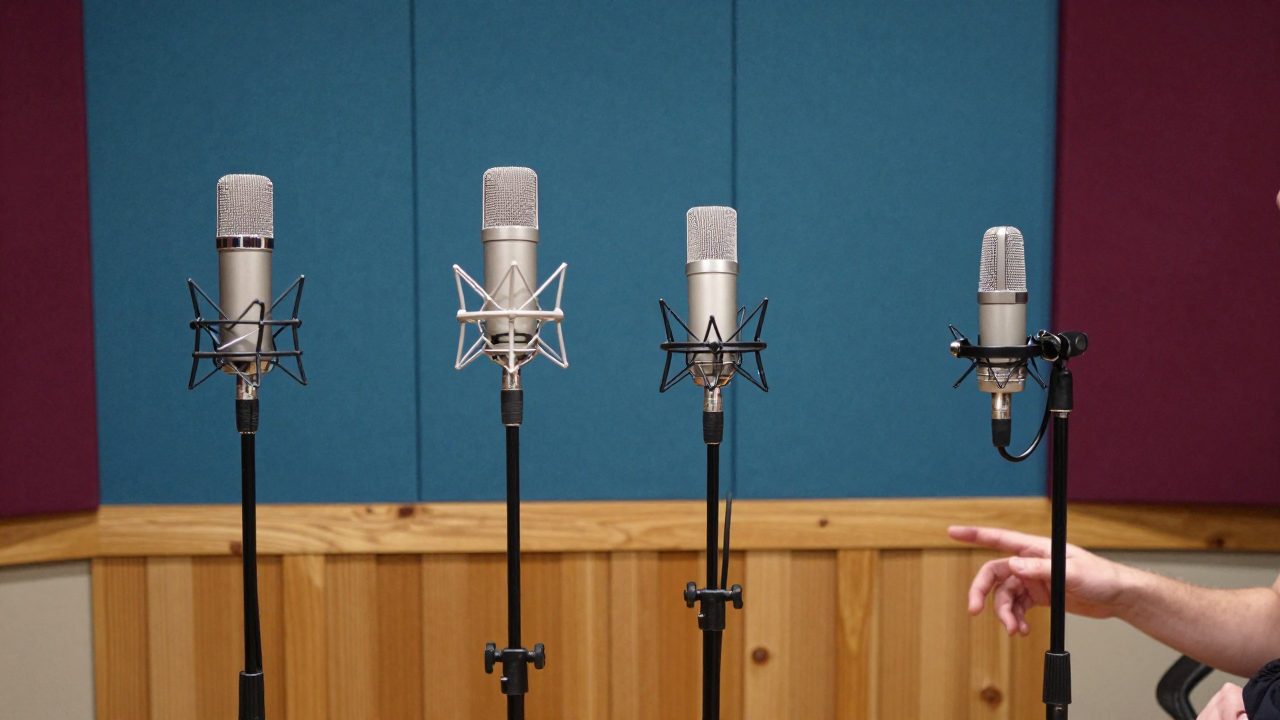
Microphone choice is one of the questions we are asked most often. There is no universal answer: a mic that flatters one voice can make another sound harsh. But a few simple ideas help you make an informed choice, whether you record at home or come to the studio.
The three main families
Dynamic microphones
Robust and not very sensitive, they mostly pick up what is close to them. That is an advantage in an untreated room: they hear less reverb and background noise. They handle high sound levels, which makes them a good choice for powerful voices, rock, heavily projected rap and speech (podcast, radio). Models such as the Shure SM7B or Electro-Voice RE20 are broadcast standards.
Condenser microphones
More sensitive and detailed, they capture nuance, harmonics and the air around the voice. This is the most common studio choice for singing. In return, they also pick up the room: in an untreated bedroom they record reverb and noise. They need phantom power (48 V). Widely used large-diaphragm models in studios include the Neumann U 87 Ai and the AKG C414.
Tube microphones are a variant of condensers: they often add density and a smoothness in the highs that suits some voices.
Ribbon microphones
Less common for vocals, they give a soft sound with naturally rounded highs. They can suit a very bright or sibilant voice, or a vintage aesthetic. They are more fragile and need a preamp with plenty of gain.
Polar pattern
The polar pattern describes how the mic picks up sound depending on direction:
- Cardioid: picks up mainly the front and rejects the rear. The standard setting for vocals.
- Omnidirectional: picks up in all directions, more natural but more sensitive to the room.
- Figure-of-eight: picks up front and back, useful for two singers facing each other or certain stereo techniques.
Some condensers let you switch patterns; when in doubt, stay on cardioid.
Proximity effect
The closer you get to a directional mic, the more the low end is boosted. It is a tool: a singer can move closer for a warm, intimate voice, or back off on a powerful passage. But too close, the voice gets muddy and plosives ("p", "b") cause bursts of air. A pop filter placed a few centimetres from the mic reduces the problem.
The room matters as much as the mic
An expensive mic in a reverberant room often gives a worse result than a modest one in a dry space. If you record at home, start by treating the immediate surroundings: a duvet behind you, heavy curtains, a wardrobe full of clothes. And prefer a dynamic mic if the room is really live.
How we choose at the studio
- We listen to your voice as you speak, then on a few lines of the song.
- We set up two or three microphones side by side and record the same passage on each.
- We listen together, level-matched, and you choose the one that sounds most like you.
- We then adjust distance and angle to refine the sound.
This test takes about fifteen minutes and is part of every vocal recording session.
Key points
- Dynamic: untreated rooms, powerful voices, speech.
- Condenser: detail and nuance, in a treated room.
- Ribbon: smoothness, bright voices or a vintage aesthetic.
- Cardioid by default, a pop filter, distance matched to intent.