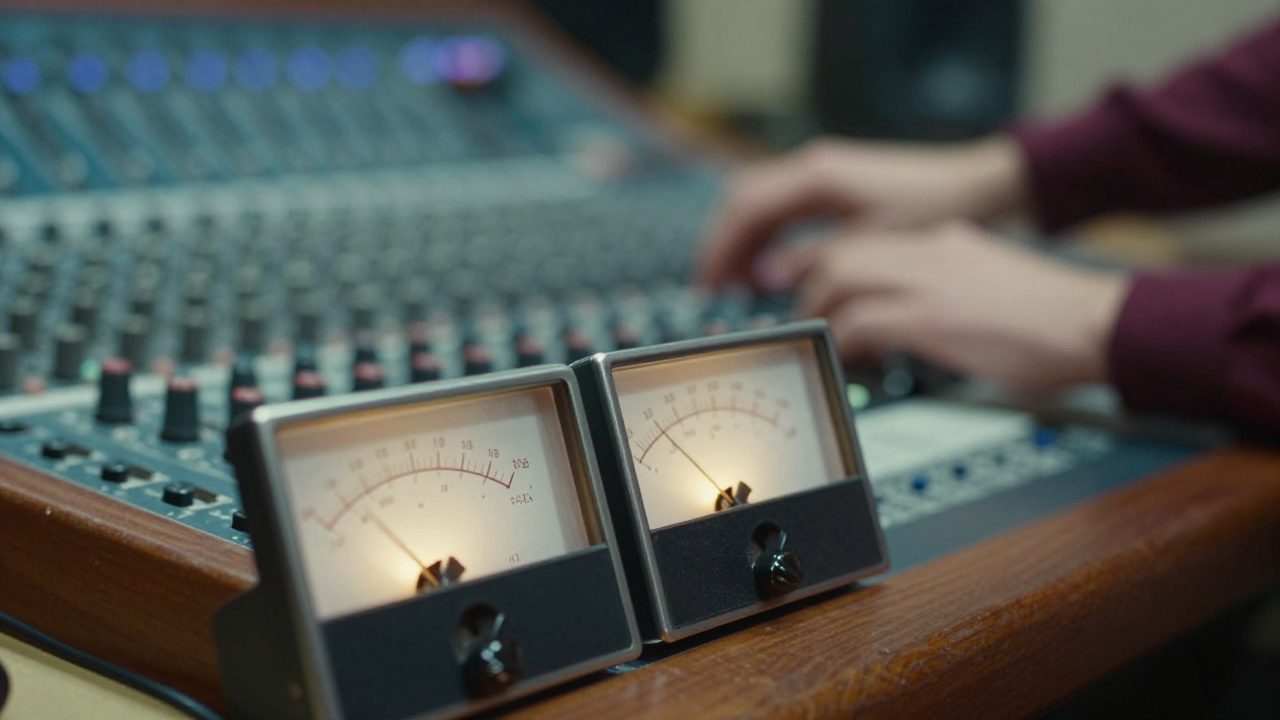
For years, the loudness war pushed studios to master ever louder, at the expense of dynamics. With streaming, the rules have changed: most platforms adjust playback volume so all tracks seem roughly as loud. Understanding this mechanism leads to better decisions in mastering.
What is a LUFS?
LUFS (Loudness Units relative to Full Scale) is a unit that measures perceived loudness, not just the electrical level of the signal. It is defined by Recommendation ITU-R BS.1770 and adopted in Europe by EBU Recommendation R 128. A LUFS measurement accounts for the ear's sensitivity to different frequencies: a powerful bass weighs less than a midrange sound at the same level.
Three measurements are commonly used:
- Integrated loudness, calculated over the whole track. This is the value platforms use.
- Short-term loudness (over 3 seconds), useful to compare a verse and a chorus.
- Momentary loudness (over 400 milliseconds), which follows fine variations.
Alongside these is true peak, expressed in dBTP. It estimates the signal's peak after analog reconstruction or encoding, which can exceed the value of the digital samples.
How platforms normalise
Normalisation means measuring each track's integrated loudness and then adjusting its playback volume towards a target value. A track mastered louder than the target is turned down; a quieter track is sometimes turned up, sometimes left as is, depending on the platform and the listener's settings.
Targets vary between services and change over time. At the time of writing, several major platforms state a default target of around −14 LUFS integrated, while others sit closer to −16 LUFS. Some also offer an "album" mode that keeps the level differences between tracks on the same record. It is therefore more useful to understand the principle than to aim for a single number.
Platform values are set by the platforms and may change without notice. Check their official documentation at the time of your release.
Louder does not mean better
To make a track louder, you reduce its dynamics with compressors and limiters. Beyond a certain point, transients (the attack of a snare, a guitar) get blunted and the sound becomes flat. If the platform then turns the track down to its target, it does not sound louder than the others: it simply sounds less alive.
Conversely, a more dynamic track, mastered slightly below the target, keeps its impact and breathing space. On many platforms it will play back at a very similar volume.
The role of true peak
When encoding to lossy formats (AAC, Ogg Vorbis, MP3), the signal can produce higher peaks than the original file. If the master is already at the maximum, those peaks cause audible distortion. It is therefore commonly recommended to leave some headroom, for example a true peak of −1 dBTP, or more for a very dense master.
How we choose the level
At the studio we do not start from a target value but from the song. An intimate acoustic piece does not need the same level as an electronic track made for clubs. Our process:
- We listen to the mix and the references you gave us.
- We set the mastering so the track sounds its best, controlling dynamics and true peak.
- We measure integrated loudness and simulate normalised playback to check the track holds up against your references.
- If you need it, we produce a specific version (club, radio, vinyl).
What about radio, TV or sync?
Broadcast follows stricter standards. In Europe, EBU R 128 sets a target of −23 LUFS for programmes, with a maximum true peak of −1 dBTP. If your track is intended for an advert, a film or a programme, ask the broadcaster for their technical specification: we will prepare a compliant file.
Key points
- LUFS measures perceived loudness; platforms use it to normalise.
- An overly loud master will be turned down, having lost dynamics for nothing.
- Leave true-peak headroom to avoid distortion on encoding.
- Choose the level by style and destination, not by a single number.